You Won’t Believe These 7 Hidden Viewpoints in Lalibela
Lalibela, Ethiopia isn’t just about ancient rock-hewn churches—there’s a whole other side most travelers miss. I’m talking about breathtaking viewpoints most guides don’t mention. From sunrise over monolithic sanctuaries to secret ridges with panoramic views, these spots transformed my trip from ordinary to unforgettable. If you're planning to visit, trust me—you need to see Lalibela from above. These elevated perspectives do more than offer scenic beauty; they deepen your understanding of a place where faith shaped the landscape over centuries. Standing high above the stone-carved sanctuaries, you begin to grasp the vision of those who built this holy city in the mountains. This journey is not just about ticking off UNESCO sites—it’s about connection, stillness, and seeing the sacred from a new angle.
Discovering Lalibela Beyond the Churches
When most travelers think of Lalibela, their minds turn immediately to the eleven medieval rock-hewn churches, carved directly from volcanic tuff with chisels and devotion. These architectural marvels—Bete Giyorgis, Bete Medhane Alem, and others—are rightly celebrated. Yet, focusing only on the churches is like reading the first chapter of a profound book and closing it. The surrounding highland terrain, shaped by both nature and centuries of spiritual practice, holds quiet vantage points that enrich the experience in ways few expect. These elevated outlooks are not tourist traps; they are natural extensions of the pilgrimage, offering context and contemplation.
The town sits at over 2,600 meters above sea level in the Ethiopian Highlands, where crisp air, rolling hills, and dramatic escarpments frame the sacred complex. From above, the layout of the churches—connected by tunnels, trenches, and prayer paths—reveals a deliberate design, often interpreted as a symbolic representation of Jerusalem. This spiritual geography becomes visible only when viewed from elevation. The viewpoints allow visitors to witness how faith and function intertwined: the site’s isolation offered protection, its rock formations provided building material, and its height reinforced its sanctity.
Walking the same paths that pilgrims have taken for generations, you begin to sense the deeper purpose behind Lalibela’s creation. It was not built merely as a place of worship but as a spiritual journey mapped onto the land. The elevated perspectives help modern travelers step into that narrative, seeing not just individual structures but a living, breathing religious landscape. By stepping back—literally and figuratively—visitors gain a fuller appreciation of Lalibela’s significance. This broader view transforms sightseeing into a more meaningful form of engagement, where wonder is matched by understanding.
The Magic of Sunrise at Church Hill Overlook
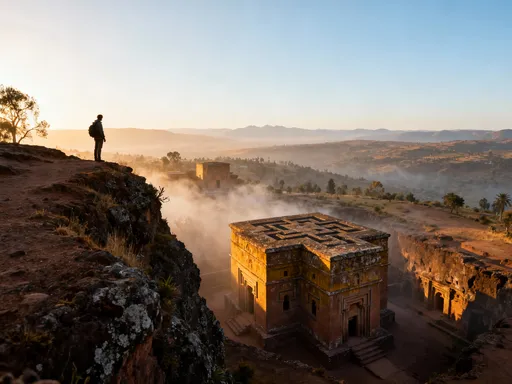
One of the most transcendent experiences in Lalibela is watching the sunrise from the natural plateau west of Bete Medhane Alem, the largest monolithic church in the complex. Long before the first tour groups arrive, a soft glow begins to paint the eastern sky. As the sun crests the highland horizon, golden light spills across the valley, illuminating the rooftops of the northern church cluster like a divine spotlight. Mist curls in the trenches below, swirling around the ancient stone as if guarding centuries of prayer. In that quiet moment, with only the distant crow of a rooster or the rustle of a passing goat, the site feels untouched by time.
This vantage point is easily accessible with a 15-minute walk from the town center, requiring no special permissions or strenuous climbing. Yet, few visitors make the effort. Most arrive later in the day, when the spiritual stillness has given way to the hum of guided tours and camera shutters. Those who rise early are rewarded not just with perfect lighting for photography but with a rare sense of intimacy. The air is cool and clean, carrying the faint scent of eucalyptus from nearby groves. The silence is not empty—it is full, almost reverent, as if the land itself is pausing to witness the dawn.
Travel experts and seasoned pilgrims alike agree: sunrise here is when Lalibela reveals its true soul. The interplay of light and shadow emphasizes the scale and precision of the rock-cut architecture, making the churches appear both monumental and delicate. It’s a moment that lingers in memory long after the journey ends. For families, this experience can be especially meaningful—a chance to share stillness and beauty with children or elders, to pause and reflect together in a world that rarely encourages such moments. If your visit includes only one viewpoint, let it be this one at first light.
The Hidden Ridge Behind Bete Merkorios
While most visitors follow the well-trodden paths between the main churches, few venture behind Bete Merkorios, one of the southern cluster’s most dramatic structures. Those who do are rewarded with a rugged, elevated trail that leads to a narrow ridge offering a breathtaking, unobstructed view of the eastern church group. From this vantage, you look directly into the deep trenches that separate the sanctuaries, seeing how they are carved at different levels, connected by hidden passages and stairways. The perspective is raw and unfiltered—no railings, no signs, no crowds. Just stone, sky, and silence.
The climb is modest but uneven, with loose gravel and natural rock steps that demand attention. Sturdy walking shoes are essential, especially for older travelers or those unaccustomed to high-altitude terrain. Yet the effort is well worth it. From the ridge, the scale of Lalibela’s engineering becomes clear. The churches are not isolated monuments but parts of a larger, integrated system—each positioned with purpose, both spiritually and structurally. The deep channels that surround them served not only as boundaries but also as symbolic moats, separating the sacred from the everyday world.
What makes this viewpoint especially powerful is its authenticity. Locals sometimes use this path for quiet prayer or meditation, adding a living spiritual dimension to the experience. You may encounter an elderly woman in traditional white shawl pausing to whisper a prayer, or a young priest walking contemplatively toward the church. These moments are not staged; they are part of the ongoing life of Lalibela. For visitors, witnessing such scenes fosters a deep sense of respect and connection. This is not a museum frozen in time but a living center of faith, where past and present coexist in harmony.
Panoramic Vista from the Northern Highlands Trail
Extending beyond the main church complex, a lesser-known footpath winds northward into the Ethiopian highlands. This trail, often used by local farmers and shepherds, gradually ascends through terraced fields, eucalyptus groves, and clusters of wild sage. After about 30 minutes of steady walking, you reach a grassy knoll that opens into a sweeping panoramic view of the entire Lalibela basin. From this height, you can identify the locations of all eleven churches, their positions forming a pattern that echoes ancient religious symbolism. The tunnels and trenches that connect them become visible as a network—like veins carrying spiritual energy through the stone.
This vista offers something rare: a complete mental map of Lalibela. On the ground, the site can feel labyrinthine, with narrow passages and sunken courtyards creating a sense of mystery. From above, the intentional design comes into focus. Historians believe the layout reflects a symbolic New Jerusalem, built by King Gebre Mesqel Lalibela in the 12th century as a pilgrimage destination for Ethiopian Christians. Seeing the full scope of this vision—from the isolation of the site to the alignment of the structures—deepens appreciation for the ambition and faith behind its creation.
Farmers often pass along the trail, greeting hikers with warm smiles and simple waves. Some may pause to share a piece of injera or offer directions. These interactions remind visitors that Lalibela is not just a historical site but a living community. The land is still worked, the traditions still honored, and the faith still lived. Bring water, a wide-brimmed hat, and sunscreen—exposure is high at this altitude, and the sun can be intense by midday. But the effort is repaid with a perspective that few tourists ever experience: a view that encompasses both history and daily life in one breathtaking sweep.
The Overlook Near Saint Gabriel Church
To the southeast of the main complex, near the newer Saint Gabriel Church—also known locally as Abba Mesqel—a gentle slope leads to a quiet clearing often used by pilgrims for prayer and reflection. Unlike the more rugged viewpoints, this one is easily accessible, making it ideal for families, older travelers, or those with limited mobility. The path is well-worn but not paved, winding through low shrubs and wildflowers. At the top, a flat area offers a serene view back toward the main church cluster, with the vast Ethiopian plateau stretching endlessly behind it.
What makes this spot especially moving is its atmosphere. On regular days, the air is still and peaceful, broken only by the distant call of a church bell or the murmur of a prayer. But during festival times—such as Timket (Epiphany) or Meskel (Finding of the True Cross)—the energy shifts. The clearing fills with pilgrims in white robes, their chants rising with the wind, blending with the sound of traditional drums and horns. From this vantage, you can see processions moving between churches, torches glowing at night, and thousands gathered in devotion. It’s a powerful reminder that Lalibela is not just a destination for tourists but a living center of faith.
Because this viewpoint is less advertised, it remains uncrowded and undisturbed. There are no souvenir vendors, no tour groups shouting for attention. Instead, you find space for quiet contemplation, a chance to sit and absorb the landscape. Parents can share the moment with children, explaining the significance of what they see. Grandparents can rest on a rock and reflect in silence. The site’s accessibility ensures that everyone, regardless of age or ability, can experience the spiritual beauty of Lalibela from above. It’s a gentle reminder that meaningful travel is not always about adventure—it’s about presence.
Why Viewpoints Enhance Cultural Understanding
Seeing Lalibela from above is not merely a photographic opportunity—it is a form of cultural immersion. When you stand at elevation, you gain spatial awareness that transforms your understanding of the site. You see how the churches are positioned for both defense and symbolism, how the trenches create natural acoustics for chanting, and how the entire complex is integrated into the natural landscape. These insights are difficult to grasp at ground level, where the focus is often on individual carvings or architectural details. From above, you see the whole—a masterpiece of planning, faith, and engineering.
Experts in heritage tourism emphasize that elevated perspectives increase visitor engagement and retention. A study published in the Journal of Travel Research found that travelers who experienced sites from multiple vantage points reported deeper emotional connections and better recall of historical context. In Lalibela, this is especially true. The bird’s-eye view reveals the symbolic layout—north and south church groups representing earthly and heavenly Jerusalem—and the intentional isolation of the site, which allowed it to remain a spiritual refuge for centuries.
Moreover, these viewpoints foster a sense of humility and awe. They remind us that human achievement is often shaped by the land, not imposed upon it. The builders of Lalibela did not flatten the terrain; they worked with it, carving sanctuaries from existing rock, following natural fissures and contours. This harmony between nature and faith is visible only when you step back. By combining ground-level exploration with elevated observation, travelers create a richer, more balanced understanding. It’s not about choosing one over the other—it’s about experiencing both, letting each perspective inform the other.
Practical Tips for Visiting Lalibela’s Viewpoints
Visiting Lalibela’s hidden viewpoints requires preparation, but the rewards far outweigh the effort. The town’s high altitude—over 2,600 meters—means that even short walks can be tiring, especially for those coming from lower elevations. To avoid fatigue, pace yourself. Begin hikes early in the morning when temperatures are cooler and the air is freshest. This also helps you avoid the midday heat and the peak hours of tourist traffic, ensuring a more peaceful experience.
Hiring a local guide is one of the best decisions you can make. These knowledgeable individuals not only know the safest and most scenic routes but can also share stories, historical context, and cultural insights that enrich your journey. Many guides are former priests or lifelong residents who speak with deep affection about their hometown. They can lead you to unmarked paths, explain the significance of certain rock formations, and help you navigate respectfully during religious ceremonies.
Dress in layers. The temperature in the Ethiopian Highlands can shift rapidly—from chilly mornings to warm afternoons. A lightweight jacket, a scarf, and a hat are essential. Wear sturdy, comfortable shoes with good grip, especially for trails like the ridge behind Bete Merkorios, where the terrain is uneven. Bring water, snacks, and sunscreen, as shade is limited on open ridges.
Respect is key. Many viewpoints are near active prayer areas or used by pilgrims for meditation. Avoid loud conversations, refrain from intrusive photography, and follow local customs—such as covering your shoulders or removing your shoes when appropriate. Most viewpoints are free to access and unmarked, so a GPS-enabled map or offline navigation app can be helpful. Finally, consider combining your hike with a short cultural stop—like sharing tea with a local family or visiting a nearby weaving cooperative. These small moments often become the most cherished memories of a trip.
Lalibela’s soul isn’t only in its stones—it’s in the silence between them, the sky above, and the land that holds them. By seeking out these viewpoints, you don’t just see the site—you feel it. In a world of rushed travel, taking time to look down from above might be the most meaningful journey of all.