You Won’t Believe What Chennai’s Architecture Hides
Chennai isn’t just about beaches and temples—it’s a living museum of architectural fusion. Walking its streets, I was stunned by how Dravidian spires, colonial facades, and modern designs stand side by side, each telling a different chapter of India’s story. From intricately carved temples to British-era buildings painted in sun-bleached pastels, the city’s skyline is a conversation between eras. This is culture carved in stone and shaped by time. Every archway, courtyard, and tower reflects generations of craftsmanship, belief, and adaptation. To walk through Chennai is to witness a city where history doesn’t reside in textbooks—it rises around you, in color, shadow, and form. Here, architecture is not merely functional; it is memory made visible.
The Soul of South Indian Design: Dravidian Temples That Take Your Breath Away
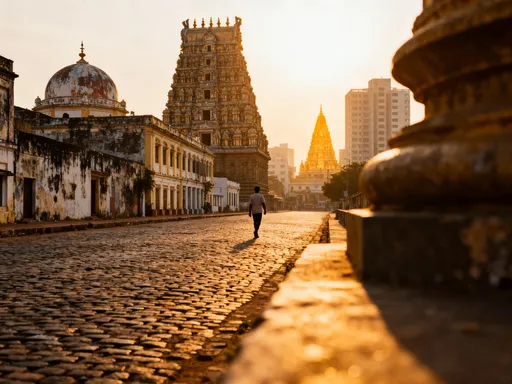
At the heart of Chennai’s architectural identity lies the Dravidian tradition, a style that has flourished in South India for over a thousand years. This ancient form is best experienced at the Kapaleeshwarar Temple in Mylapore, one of the city’s most revered spiritual centers. Rising above the bustling lanes, its 120-foot gopuram—towering gateway—bursts with sculpted figures of deities, mythical creatures, and celestial dancers. Each layer of the tower represents a different cosmic plane, drawing the devotee’s gaze upward toward the divine. The temple’s layout follows strict Vastu Shastra principles, with concentric courtyards guiding movement from the outer world into inner sanctity. This is not just design—it is spiritual geometry.
What makes Dravidian architecture so powerful is its integration of art, ritual, and environment. The temple walls are not merely decorative; they narrate stories from Hindu epics like the Ramayana and Mahabharata, serving as visual scriptures for generations. The stone carvings, often done in granite or stucco, withstand Chennai’s humid climate while maintaining intricate detail. Inside the sanctum, the air is thick with the scent of jasmine and sandalwood, and the rhythmic chanting of priests echoes through corridors cooled by natural ventilation. These spaces are not frozen relics—they are alive, pulsing with daily pujas, festivals, and community gatherings.
The Kapaleeshwarar Temple is dedicated to Lord Shiva, and its design reflects the philosophical essence of his worship—destruction as a path to renewal. The temple tank, though no longer in active ritual use, once played a crucial role in both purification and microclimate regulation. Even today, the surrounding mandapams (pillared halls) host classical music performances during the December music season, proving that sacred spaces also serve cultural ones. Other temples like the Marundeeswarar Temple in Thiruvanmiyur and the Ashtalakshmi Kovil near Elliot’s Beach demonstrate regional variations, incorporating coastal adaptations and modern materials without losing symbolic depth.
For visitors, understanding Dravidian architecture means recognizing that every element has meaning. The vimana (main shrine) sits directly beneath the gopuram, aligning earthly and celestial realms. The use of symmetry, cardinal orientation, and hierarchical layering reflects a worldview rooted in balance and order. Women often lead family visits here, bringing children to light lamps and offer prayers, continuing traditions passed down through matriarchal lines. These temples are not only places of worship but anchors of identity, especially for Tamil-speaking families who see them as emblems of cultural pride and continuity.
Colonial Echoes: When British Grandeur Met Tamil Land
Just a few kilometers from the Kapaleeshwarar Temple, the skyline shifts dramatically. In George Town, Chennai’s historic commercial district, rows of 18th and 19th-century buildings stand as testaments to British colonial ambition. These structures were not mere imports from England—they evolved into something uniquely adapted to South Indian conditions. The British, facing Chennai’s intense heat and monsoon rains, modified Georgian and Gothic styles with wide verandahs, high ceilings, and louvered windows that allowed cross-ventilation. The result was a functional yet imposing architectural language that spoke of authority while quietly learning from local wisdom.
One of the most striking examples is the Madras High Court, a vast complex painted in soft yellow and white, with red-tiled roofs and clock towers that dominate the Marina skyline. Built in the late 1800s, it combines Gothic Revival elements—pointed arches, turrets, and ribbed vaults—with Indian craftsmanship in wood and stonework. The building’s double-height corridors were designed to catch sea breezes, a practical response to the coastal climate. Similarly, Fort St. George, established in 1644, is the oldest English fortress in India and remains an active military and administrative site. Its ramparts overlook the Bay of Bengal, and within its walls lies St. Mary’s Church, the oldest Anglican church east of Suez, where Robert Clive was married.
These buildings were centers of power, but they also became melting pots of culture. The colonial-era post office, customs house, and railway headquarters employed thousands of Tamil workers and artisans, whose influence subtly shaped the final designs. For instance, the use of local laterite stone and lime plaster helped regulate indoor temperatures, while carved wooden brackets often featured floral motifs inspired by Indian flora rather than European patterns. Even the layout of George Town’s streets—narrow lanes branching off broader avenues—follows pre-colonial trade routes, showing how the British adapted to existing urban logic rather than erasing it.
Today, many of these buildings face challenges of preservation. Some have been repurposed: the old Central Railway Station now houses a heritage museum, and former mercantile offices host startups and cultural centers. Conservation efforts led by organizations like INTACH (Indian National Trust for Art and Cultural Heritage) aim to restore facades while maintaining structural integrity. Walking through George Town, one sees laundry drying on wrought-iron balconies, street vendors selling banana fritters beneath arched colonnades, and office workers sipping coffee in shaded arcades—proof that colonial architecture, though born of empire, has been fully absorbed into the rhythm of everyday Tamil life.
Indo-Saracenic: Where East Met West in Spectacular Style
Perhaps the most fascinating chapter in Chennai’s architectural story is the Indo-Saracenic style—a deliberate fusion of Indian, Islamic, and European elements that emerged in the late 19th century. Unlike pure colonial or traditional Dravidian forms, this hybrid was neither fully foreign nor entirely local. It was, instead, a symbolic compromise—a way for the British to project imperial strength while acknowledging Indian cultural richness. The result is a series of grand public buildings that feel both exotic and familiar, like dreams translated into stone.
The Senate House of the University of Madras stands as one of the finest examples. Designed by Robert Fellowes Chisholm, a British architect deeply influenced by Indian design, it features onion domes, horseshoe arches, and jali (lattice) screens, all crafted with South Indian precision. The central dome, inspired by Mughal architecture, rises above a colonnaded courtyard where students gather under flowering rain trees. Inside, teak wood beams and stained glass create a play of light and shadow, blending Victorian elegance with tropical serenity. Similarly, the Victoria Public Hall—originally built as a town hall in 1887—boasts minarets, chhatris (elevated pavilions), and arched galleries that echo both Islamic and Rajput styles, yet sit comfortably beside Tamil Nadu’s legislative assembly.
What makes Indo-Saracenic architecture so compelling is its intentionality. It was not accidental fusion but a calculated effort to create a “new Indian style” that could represent the empire’s reach while incorporating native aesthetics. This duality is evident in the way domes sit atop Dravidian bases, or how Islamic calligraphy appears alongside Hindu floral carvings. The style was used primarily for civic buildings—libraries, museums, railway stations—suggesting that the British wanted these institutions to feel accessible, even welcoming, to Indian citizens.
Yet, the legacy is complex. While some view these buildings as beautiful examples of cultural synthesis, others see them as architectural propaganda—structures meant to legitimize colonial rule through aesthetic inclusivity. Still, time has softened these tensions. Today, the Senate House hosts academic ceremonies where Tamil scholars receive degrees beneath Mughal-inspired domes. The Victoria Public Hall, after years of neglect, has been restored and now serves as a cultural venue for music recitals and art exhibitions. In this way, the Indo-Saracenic style has outlived its political origins and become part of Chennai’s shared heritage.
Chennai’s Hidden Gems: Lesser-Known Buildings With Big Stories
Beyond the famous temples and colonial landmarks lie quieter, often overlooked structures that tell equally powerful stories. In neighborhoods like Triplicane, Royapettah, and West Mambalam, ancestral homes with carved wooden doors and tiled roofs still stand, though many are fading under layers of paint and time. These residences, built by Tamil merchants, scholars, and artisans in the early 20th century, reflect a domestic architecture that balanced privacy, climate control, and cultural expression. Courtyards allowed light and air to circulate, while high ceilings reduced heat buildup—a practical wisdom passed down through generations.
One such gem is the Pycroft’s Building in Egmore, a former residence of a British civil servant that now houses government offices. Its wraparound verandahs, stained glass windows, and terracotta tiles speak of a lifestyle that blended European comfort with Indian craftsmanship. Nearby, the Connemara Public Library—part of the same complex—features a magnificent reading room with a glass skylight and teak bookshelves that rise to the ceiling. Opened in 1896, it remains one of Asia’s oldest public libraries and a sanctuary for readers of all ages.
Another hidden treasure is the Roxy Theatre in T. Nagar, an Art Deco cinema hall from the 1940s. With its geometric façade, neon accents, and curved ticket booth, it recalls the glamour of early Indian cinema. Though fewer films are shown today, the building remains a beloved landmark, especially among older residents who remember weekend outings with their parents. Similarly, the old Hindu Theatre in Royapettah, though no longer operational, still displays its ornate plasterwork and proscenium arch, a reminder of Chennai’s vibrant theatrical past.
These lesser-known sites matter because they represent everyday history—the lives of teachers, shopkeepers, and families who shaped the city away from the spotlight. Many of these buildings are at risk of demolition or insensitive renovation, but grassroots efforts are growing. Local heritage walks, organized by community groups and historians, invite residents to rediscover these spaces. Women’s associations often lead temple-to-temple or home-to-home tours, emphasizing the role of women in preserving family homes and neighborhood traditions. By celebrating these quiet monuments, Chennai honors not just grand narratives but the intimate textures of lived experience.
Modern Chennai: How New Architecture Respects the Past
As Chennai grows into a modern metropolis, its skyline is increasingly defined by glass towers, shopping malls, and high-rise apartments. Yet, a new generation of architects is rethinking urban development, seeking ways to honor the city’s heritage while meeting contemporary needs. The best examples of modern architecture in Chennai do not reject the past—they reinterpret it. Courtyard homes are reimagined in apartment complexes with central atriums that promote natural light and airflow. Temple motifs appear in abstract forms on building facades, connecting new structures to cultural memory.
One notable project is the Cholamandal Artists’ Village, located just outside the city. Designed in the 1960s by artist K.C.S. Paniker, it blends modernist simplicity with traditional Tamil layouts. Houses are arranged around open spaces, with tiled roofs and exposed brick walls that respond to the coastal climate. Today, it remains a vibrant community of painters, sculptors, and ceramicists who live and work in harmony with their environment. Similarly, the DakshinaChitra Heritage Museum, though technically in nearby Mamallapuram, offers a model of how traditional Tamil, Kerala, and Andhra house types can be preserved and adapted for educational and cultural use.
Contemporary architects like Gopalakrishnan and Venkataramanan advocate for what they call “climate-responsive design,” using materials like perforated brick, lime plaster, and recycled wood to reduce energy consumption. Buildings like the IIT Madras Research Park incorporate solar panels, rainwater harvesting, and green roofs, proving that sustainability and tradition can coexist. Even corporate offices are adopting Tamil design cues—using jali screens for privacy and shade, or incorporating kolam-inspired patterns in flooring and landscaping.
This shift is especially meaningful for families and women who value both comfort and cultural continuity. Modern homes now feature prayer rooms integrated into living spaces, often oriented eastward with small gopuram-like frames. Schools and community centers are being built with open-air corridors and shaded courtyards, echoing temple architecture. These choices reflect a deeper desire: to raise children in environments that feel rooted, even as the city changes around them. Architecture, in this sense, becomes a form of parenting—a way to pass down values through space and light.
Walking the City: A Local’s Guide to Experiencing Architectural Layers
To truly understand Chennai’s architectural richness, one must walk it. A recommended route begins in Mylapore, at the Kapaleeshwarar Temple, where the morning light enhances the gopuram’s colors and the sound of bells fills the air. After observing the rituals, visitors can stroll through the surrounding streets, noting the contrast between ancient shrines and colonial-era bungalows with tiled roofs and pillared porches. A short auto-rickshaw ride leads to Triplicane, home to the historic Amir Mahal and several 19th-century mansions that once belonged to Tamil nobility.
From there, heading toward George Town offers a dramatic shift. The bustling streets are lined with warehouses, banks, and post offices from the British era, many still in use. Key stops include the Madras High Court, the Senate House, and the Ripon Building, which houses the Chennai Corporation. These structures are best seen in the late afternoon when the sun casts long shadows across their facades, highlighting textures and details. Visitors should pause at a roadside stall for a cup of authentic filter coffee—a strong, milky brew served in steel tumblers—before continuing to Fort St. George, where the museum offers a concise history of the city’s founding.
For a more intimate experience, joining a guided heritage walk is highly recommended. Organizations like the Chennai Heritage Foundation and Madras Inherited offer themed tours—some focused on colonial architecture, others on temple art or domestic life. These walks are often led by local historians or retired educators, many of whom grew up in the neighborhoods they describe. They share personal memories—of playing cricket in temple courtyards, of visiting grandparents’ homes with courtyards filled with potted plants—adding emotional depth to the physical landscape.
Respect is essential when visiting sacred or private spaces. Women are advised to dress modestly when entering temples, covering shoulders and legs, and removing footwear before stepping inside. Photography may be restricted in certain areas, especially during rituals. The best times to visit are early morning or late evening, when the heat is milder and the atmosphere more contemplative. Above all, travelers are encouraged to move slowly, to look up as well as down, and to engage with residents—whether a shopkeeper, priest, or neighbor—who may offer unexpected insights into the city’s soul.
Why Architecture Is Chennai’s True Cultural Language
In a world of fleeting trends and digital distractions, Chennai’s architecture stands as a testament to endurance. Its buildings do more than shelter—they communicate. From the sacred geometry of Dravidian temples to the adaptive brilliance of colonial verandahs, from the symbolic fusion of Indo-Saracenic domes to the quiet dignity of ancestral homes, each structure tells a story of resilience, creativity, and identity. These are not just monuments to admire from a distance; they are living parts of daily life, woven into the routines of worship, work, and family.
For women, especially, architecture often holds deep personal meaning. The temple where a grandmother prayed, the house where a mother raised children, the school where a daughter learned her first song—these spaces become vessels of memory and continuity. In Chennai, such places are not locked behind glass; they are lived in, maintained, and passed on. This is a city where heritage is not curated but cultivated, where the past is not dead but present in every stone, beam, and courtyard.
Travelers who come to Chennai seeking beaches or bargains may leave surprised by what they find: a city that speaks through its skyline. To look at a gopuram is to see devotion carved in stone. To stand beneath a colonial arcade is to feel the weight of history and the whisper of change. To enter a modern home with a traditional layout is to witness hope for the future, rooted in respect for the past. Architecture here is not decoration—it is dialogue.
So the next time you walk through Chennai, look beyond the surface. Notice the way sunlight filters through a jali screen, the way a temple bell echoes at dawn, the way an old doorway bears the marks of decades of use. These are not accidents—they are choices, passed down and preserved. In a rapidly changing world, Chennai reminds us that identity can be built to last. Its buildings are not just structures; they are stories. And they are still being written.